The cost of running US software in pounds
You open the company card statement at the start of the month. The Mailchimp line is £1.40 different from last month. HubSpot is £77.20, not £76.80. Zoom is £15.30, not £14.99. None of the vendors emailed to say anything had changed. None of them added users. None of them upgraded the tier.
The exchange rate did that.
If you run a UK SMB on an American SaaS stack, your bill is a different number every month and you did not change anything. That is currency exposure, and most British business owners have never thought of their software bill as a currency play. It is.
How it works
Claim: Most US SaaS vendors price in dollars and convert at the rate of the day, so your GBP bill drifts month to month. Proof: open any major US vendor's pricing page from the UK and look at the small print. Zendesk's UK pricing page lists "from $19 per agent per month" with no published GBP equivalent.[1] Mailchimp's plans show in dollars by default and convert at billing time.[2] Zapier's prices are USD with the disclaimer that "prices listed may fluctuate depending on exchange rates".[3] Action: if you are billed in GBP for any of these tools, that GBP number is computed each month from the underlying USD price and the exchange rate that day.
The vendor does not care, because their costs are in dollars too. Their engineers are paid in dollars, their AWS bill is in dollars, their offices are in dollars. Currency exposure is your problem, not theirs.
What it actually moves
Sterling against the dollar moves more than people realise. Over the twelve months to May 2026, the GBP/USD rate has ranged from a low of $1.3237 (March 2026) to a high of $1.3826 (January 2026), a swing of roughly 4.5 percent inside a single year.[4] Over that twelve months, sterling actually strengthened 2.33 percent against the dollar overall.[4] So this year the volatility went your way. Run the same chart for 2022, when sterling fell to $1.07 against the dollar, and the same volatility cost UK SMBs an average of 8 to 10 percent on every USD-priced subscription.[5]
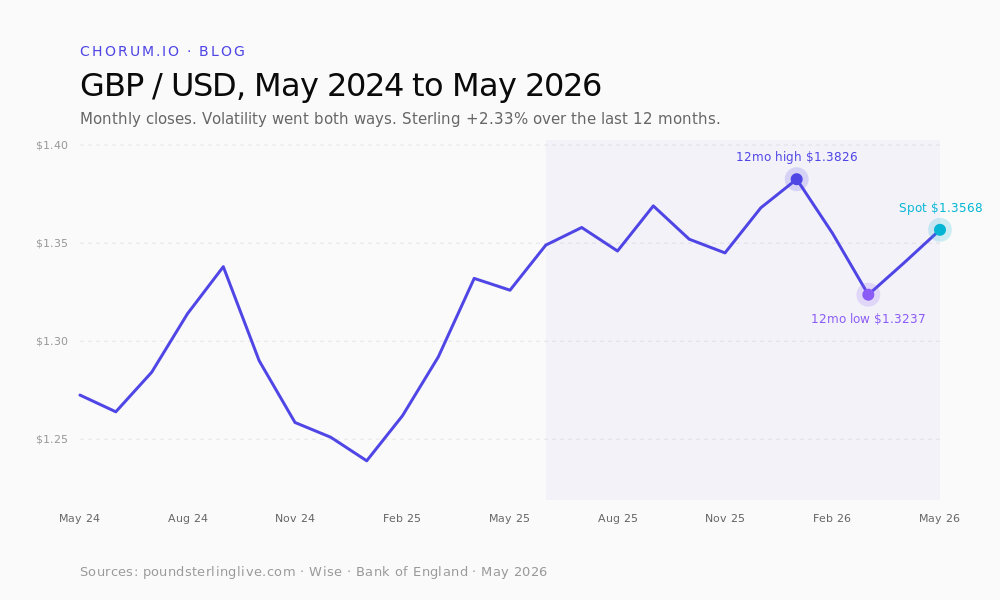
Currency exposure is not a tax. It is volatility. It moves both ways. The question is whether your operating budget is set up to absorb a 5 to 10 percent swing on a recurring expense without notice.
Underneath the currency: the upgrade ladder
Currency is the part you can see on the statement. The bigger silent cost is the tier ladder.
Every US SaaS tool is built on a tier structure designed to keep nudging you up. The starter tier is just enough to be useful and not enough to be sufficient. Features you will need within twelve months are paywalled in the next tier. By month nine, you have upgraded.
HubSpot Sales Hub Starter is £18 per seat per month, ex VAT. Sales Hub Professional is £85 per seat per month, ex VAT.[6] A 4.7x jump for the next tier. The path between them is paved with limits you will bump into: deal limits, automation limits, reporting limits, integration limits.
The currency drift compounds with the upgrade pressure. Six months in you are paying more for the same tier. Twelve months in you have moved to the next tier and the new price has already drifted up. Then the vendor sends an annual increase, often without negotiation. Mailchimp put through an 11 to 13 percent rise on legacy plan users in April 2026 and halved free-plan limits the same year.[2] Most users found out from the invoice.
Underneath the upgrade ladder: the operating-norm mismatch
US-built SaaS is not built around UK operating realities. A few examples:
VAT. US-led billing systems often add VAT badly, treat it as a US sales tax substitute, or expect you to handle it on your end.
Date format. Reports default to MM/DD/YYYY. Easy to fix once. Irritating that you have to.
Tax year. US fiscal year for the federal government runs October to September. UK tax year runs 6 April to 5 April. Annual reports default to the wrong cycle.
Address fields. "State" is a required field on far too many forms. Postcode goes in "ZIP". County is squeezed into "City line 2".
Compliance posture. SOC 2 and HIPAA dominate the security pages. Cyber Essentials and the UK GDPR are afterthoughts.
Hosting. Default region is us-east-1. Some vendors offer a UK or EU region as an upgrade. Others do not offer it at all.
None of these are individually fatal. Together they are the steady tax of running a British business on American software.
What you can do
Three options, ranked from least to most disruptive.
Option 1: live with it
Accept the currency volatility, the upgrade pressure, and the operating-norm mismatch. Treat your SaaS bill as a variable cost, not a fixed one. Budget for it growing five to ten percent a year regardless of usage.
This is what most UK SMBs do, because switching is harder than absorbing. It is a real choice. Just make sure you are making it on purpose.
Option 2: hedge inside the contract
Some US vendors offer annual prepayment locked in pounds. You pay twelve months upfront in GBP at today's rate. You give up the flexibility of monthly billing. You lock in the currency exposure for the year.
Worth it if cashflow allows and the vendor offers it. Many do not. Most that do offer it only at the higher tiers, which often forces you up the upgrade ladder anyway.
Option 3: switch to UK-priced
Replace the US tools with UK alternatives priced in pounds. The British SaaS scene is not as developed as the American one, but it exists.
For accounting, you have Xero (technically NZ but UK-priced and built around UK accounting),[7] FreeAgent (Edinburgh), Sage (Newcastle). For lightweight CRM, you have Capsule (Manchester),[8] Spotler (Suffolk).[9] For PSA aimed at MSPs, HaloPSA (Stowmarket).[10] For all of the above as one platform, you have Chorum.io (us, biased; UK-built, UK-hosted, GBP-priced).
The migration is real. So is the relief of opening your statement and finding the line items unchanged.
Who built your operating stack?
This is the bigger question.
The tools that run a UK business should be built around UK realities. UK accounting periods. UK postcodes. UK VAT. UK working patterns. UK compliance frameworks. UK pricing.
For most of the last fifteen years, if you wanted modern, well-designed SaaS, you had to take the American assumptions that came with it. There was nothing else. That is changing. Slowly, and not in every category, but it is. UK-first business software is appearing because British business owners stopped accepting that the only option was to translate their company into American conventions on the side.
What is next
Two practical steps:
Add up your USD-priced SaaS. Open the card statement, total only the US tools, and look at how the line items moved month to month over the last twelve months. The number is usually more variable than you expected.
Join the Chorum.io waiting list. We are taking on a small number of pilot customers. UK-built, UK-hosted, billed in pounds. CRM, ERP, helpdesk and warehousing live today. Marketing and field services in design. From £19 a user a month. Add your name here.
Either way, your card statement should stop being a surprise.
Sources
Zendesk. Support Pricing. 2026. Support Team plan from $19 per agent per month USD with no published GBP equivalent. zendesk.com/pricing
EmailToolTester. Mailchimp Pricing 2026: Watch Out for These Extra Costs. 2026. Mailchimp Standard from $20 per month USD; April 2026 11 to 13 percent price rise on legacy plan users; free plan contact and sending limits halved early 2026. emailtooltester.com
Zapier. Plans and Pricing. 2026. Professional plan from $19.99 per month USD annually-billed. Disclaimer that GBP prices fluctuate with exchange rates. zapier.com/pricing
PoundSterlingLive. British Pound to US Dollar History 2026. 12-month range to May 2026: low $1.3237 (14 March 2026), high $1.3826 (28 January 2026). 12-month change: +2.33 percent. poundsterlinglive.com/history/GBP-USD-2026 and wise.com
Bank of England. Statistical Database, GBP exchange rates 2022. GBP/USD low of $1.0686 on 26 September 2022. UK SMBs on USD-priced SaaS faced double-digit GBP cost increases through Q3-Q4 2022. bankofengland.co.uk/statistics/exchange-rates
TheMarketingblog. HubSpot Pricing UK: The Complete 2026 Guide. March 2026. Sales Hub Starter £18 per seat per month ex VAT, Sales Hub Professional £85 per seat per month ex VAT. themarketingblog.co.uk
Xero UK. Pricing Plans. April 2026. UK plans Ignite £15/month, Grow £28/month, Comprehensive £47/month, Ultimate £55/month, all ex VAT. xero.com/uk/pricing-plans
Capsule CRM. About. Headquartered at 20 Dale Street, Manchester, M1 1EZ, UK. capsulecrm.com/about
Spotler Group. UK-headquartered marketing automation and CRM provider, originally launched as Communigator in 2005. spotler.com
HaloPSA. UK-headquartered PSA platform for MSPs and IT service teams. usehalo.com/halopsa
Tom Adams is the founder of Chorum.io and Metis Solutions Group Ltd. He spent five years running a UK MSP on a stack of mostly American tools. The card statement was always a surprise.