Why UK SMBs end up with five SaaS tools (and how to fix it)
You start with a CRM because someone said you needed one. Then you add accounting software because tax. Then a helpdesk because customers started emailing you direct. Then an email tool because the CRM's email features are awful. Then a spreadsheet because none of the others does the one thing you really need.
Six months later you are paying for five tools, you use about a third of each, and your customer record exists in three of them with subtly different details. None of them talks to the other four properly. You have started a Zapier account. You hate yourself a little.
This is the standard British SMB tooling story. It is not a personal failing. It is the predictable shape of a SaaS market built around tool-by-tool buying. Here is how it happens, what it actually costs in 2026 pricing, and a five-step audit to start untangling it.
The size of the problem
The UK had 5.7 million private sector businesses at the start of 2025, of which 5.64 million (99.18 percent) were small businesses with 0 to 49 employees (Department for Business and Trade, Business Population Estimates 2025).[1] Almost every business this post might apply to is in that small-business population.
Most of them run on a SaaS stack of three to seven tools. There is no government statistic for the average, because nobody has the data, but a glance at any UK SMB owner's bank statement tells the story: the SaaS line items are several, separately billed, and rising.
How the sprawl happens
Three traps account for most of it.
Trap one: the free tier seduction
HubSpot's free CRM is genuinely useful. So is Capsule's. So is Pipedrive's trial. You sign up, get value, and lock in. A year later you are on the next tier, because you outgrew the free one. Switching feels like a six-month project. The free tier's job was never to stay free. It was to get you in.
The same pattern applies to Trello, Asana, monday.com, Airtable. Free tier in, paid tier later, never quite enough capability to retire the next tool.
Trap two: the function-specific habit
Each function in the business goes shopping for the best tool for its job. Sales picks a CRM. Support picks a helpdesk. Finance picks an accounting tool. Marketing picks an email platform. Operations builds a spreadsheet because no tool does what they need.
Each choice is locally rational. Globally it is a mess. Five tools, five vendors, five logins, five bills, five places customer data lives, five places it can be wrong.
Trap three: the integration optimism
"It is fine, they integrate." Three months later: the integration is one-way only. Or it requires Zapier. Or it syncs once a day, not in real time. Or the field mapping is wrong and it duplicates your customer records every time someone updates a phone number.
By the time you find out, you have already built workflows around the assumption that the integration works properly. Tearing them out is harder than putting up with the friction.
What it actually costs in 2026 prices
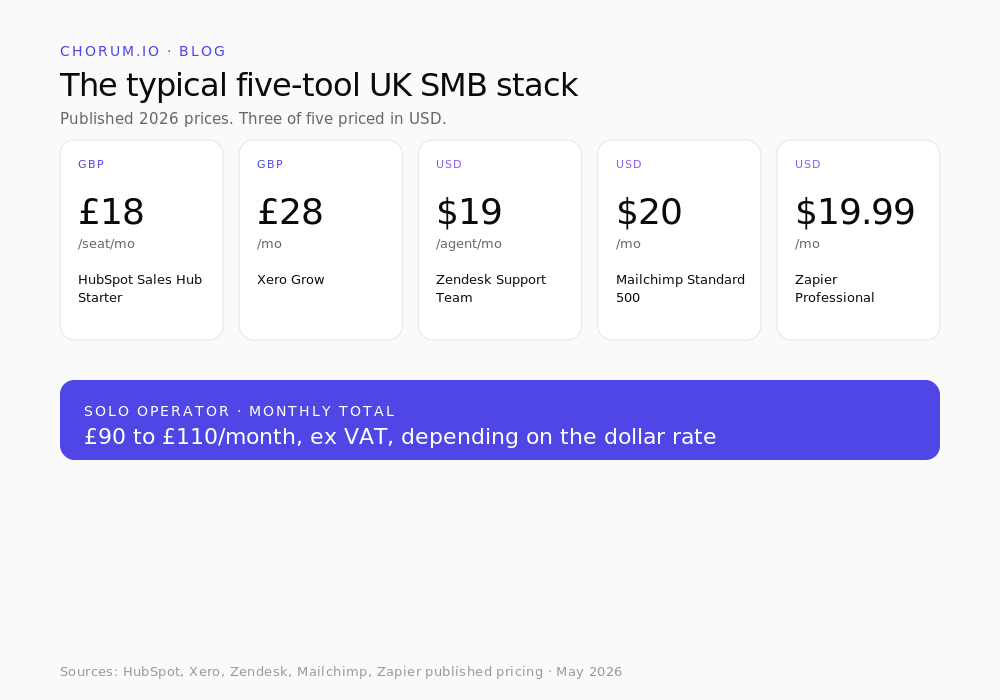
The bill is the small bit, but let us start there. A typical UK SMB stack of five common tools, priced at the published 2026 rates.
HubSpot Sales Hub Starter: £18 per seat per month, ex VAT (HubSpot UK pricing, March 2026)[2]
Xero Grow: £28 per month, ex VAT (Xero UK pricing, April 2026)[3]
Zendesk Support Team: from $19 per agent per month, billed in USD with no published GBP price (Zendesk pricing, 2026)[4]
Mailchimp Standard, 500 contacts: $20 per month USD, billed via currency conversion (Mailchimp pricing, 2026)[5]
Zapier Professional: $19.99 per month annually-billed, $29.99 monthly (Zapier pricing, 2026)[6]
For one solo operator running all five, the bill comes to roughly £90 to £110 a month depending on the dollar rate that day, before VAT. Around £1,200 a year. Already more than most owner-operators want to be paying for software they barely use a third of.
And the bill keeps rising. Mailchimp put through an 11 to 13 percent price increase on legacy plan users in April 2026, and halved the contact and sending limits on its free plan earlier in the year.[5] That is one tool, in one quarter, and most users found out from the invoice.
The real costs are bigger than the bill, though.
Time
Every customer interaction lives in two or three places. You log a call in the CRM, a note in the helpdesk, an email goes out from Mailchimp. None of them know about each other. Reconciling takes minutes a day, hours a week.
Lost deals
A customer emails support about a billing issue. The salesperson chasing them for an upgrade has no idea. They send the upsell email anyway. The customer churns instead.
Duplicated data
Same customer, three different email addresses across three systems. When you run a report, the numbers do not agree. You spend Friday afternoon reconciling instead of working.
The currency exposure
Three of the five tools above are priced in dollars. When sterling moves, your bill moves with it, with no warning and no upgrade. Sterling has actually strengthened 2.33 percent against the dollar over the last twelve months,[7] which is a quiet win this year. Run it the other way and you would be reading a different headline. Either way, a stack you did not change costs you a different number every month.
The hidden upgrade cycle
Each tool's basic tier is just enough to be useful and not enough to be sufficient. Every tool tries to nudge you up a tier. HubSpot Sales Hub Starter is £18 per seat per month. Sales Hub Professional is £85 per seat per month.[2] A 4.7x jump for the next tier. The path between them is paved with limits you will bump into: deal limits, automation limits, reporting limits.
The total real cost is the bill, plus the hours of admin, plus the deals you did not see coming, plus the upgrades you will be pushed into, plus the currency exposure you did not sign up for.
A five-step audit to fix it
Before you swap anything, audit what you have got. The audit is the work. The replacement is the easy bit.
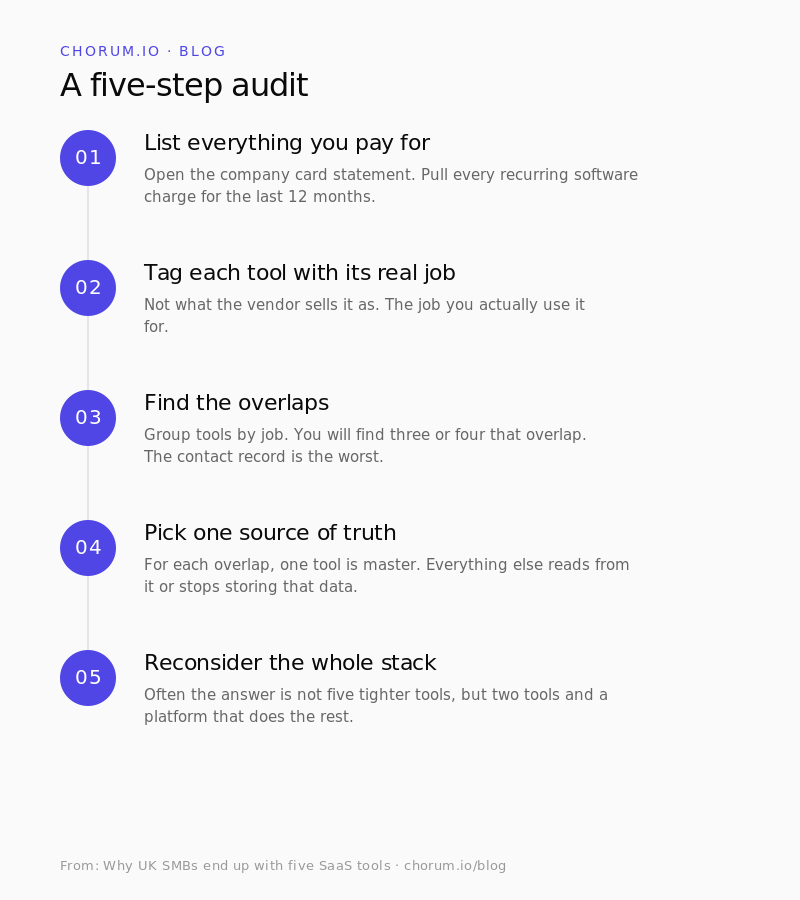
Step 1: list everything you pay for
Claim: most SMB owners cannot tell you their total SaaS spend without checking. Proof: easy enough to test. Open the company card statement and pull every recurring software charge for the last 12 months. Include the £4 a month for the Loom subscription you forgot about. Action: total it. The number is usually higher than you expected.
Step 2: tag each tool with its real job
Next to each tool, write what job you actually use it for. Not what the vendor sells it as. The job.
If you bought HubSpot for marketing automation but only use it as a contact list, the job is "contact list". If you bought Zendesk for support but only use the ticket inbox, the job is "ticket inbox".
Be honest. Most stacks have at least one tool where the real job is "I forgot to cancel".
Step 3: find the overlaps
Group tools by job. You will find three or four that overlap.
The classic UK micro-business overlap: HubSpot has contact management, Xero has contact management, Mailchimp has contact management, the spreadsheet has contact management. Four places. None agree. The contact record is the highest-friction overlap in nearly every SMB stack.
Step 4: pick one to be the source of truth
For each overlap, pick one tool to be the master. Everything else either reads from it or stops storing that data. If two tools have to keep storing the same data, the rule is one writes and the other reads, never both writing.
This is the hard step. You will have to migrate data. You will have to retrain habits. You will have to ignore the marketing emails from the tool you have demoted.
Step 5: ask whether the tool stack still makes sense
Once you have cut the overlaps, look at what is left. Often the answer is not "five tighter tools" but "two tools and a platform that does the rest".
The platform option used to mean Salesforce, NetSuite, or a six-month implementation. It does not any more. UK-built modular all-in-one platforms now exist that give you CRM, helpdesk, finance and warehousing under one login, billed in pounds, hosted in the UK. We built one. It is called Chorum.io.
The bigger picture
The five-tool problem is the predictable outcome of a SaaS market where every vendor is incentivised to be your sole tool for one function and price accordingly.
You are not a sales team or a support team or a finance team. You are a business. The tools should fit the shape of the business, not the other way around.
The fix is not "find better integrations". The fix is "stop assembling the stack from five vendors who do not know each other exist". One platform that does the operational core. The vendors who really do specialise (your accountant, your payroll, your specific industry tool) integrate with that platform.
What is next
Two practical steps:
Run the audit. Block out an hour this week. Step 1 to step 5. Even if you do not change anything afterwards, you will know what you are paying for and what for. That alone is worth the hour.
Join the Chorum.io waiting list. We are taking on a small number of pilot customers across CRM, ERP, helpdesk and warehousing. Marketing and field services ship in Q4 2026. UK-built, UK-hosted, billed in pounds. From £19 a user a month. Add your name here.
Either way, your Sundays will thank you.
Sources
Department for Business and Trade. Business Population Estimates for the UK and Regions 2025: statistical release. Published October 2025. gov.uk/government/statistics/business-population-estimates-2025
TheMarketingblog. HubSpot Pricing UK: The Complete 2026 Guide. March 2026. Sales Hub Starter £18/seat/month ex VAT, Sales Hub Professional £85/seat/month ex VAT. themarketingblog.co.uk
Xero UK. Pricing Plans. April 2026. Ignite £15/month, Grow £28/month, Comprehensive £47/month, Ultimate £55/month, all ex VAT. xero.com/uk/pricing-plans
Zendesk. Support Pricing. 2026. Support Team plan from $19/agent/month USD. zendesk.com/pricing
EmailToolTester. Mailchimp Pricing 2026: Watch Out for These Extra Costs. 2026. Mailchimp Standard from $20/month USD for 500 contacts; April 2026 11 to 13 percent price rise on legacy plan users; free plan limits halved early 2026. emailtooltester.com
Zapier. Plans and Pricing. 2026. Professional plan from $19.99/month USD annually-billed, $29.99/month USD monthly. zapier.com/pricing
PoundSterlingLive / Wise. GBP/USD Exchange Rate History 2025-2026. Sterling strengthened 2.33 percent against the US dollar in the twelve months to May 2026. wise.com/us/currency-converter/gbp-to-usd-rate/history and poundsterlinglive.com
Tom Adams is the founder of Chorum.io and Metis Solutions Group Ltd. He has spent the last fifteen years inside UK SMBs as an IT engineer, MSP owner and software builder. He still uses too many tools.