Stack consolidation: from HubSpot + Xero + Zendesk to one platform

It usually starts on a Monday. The card statement landed at the weekend. The new starter cannot find a customer record because it lives in three different tools, none of which she has been given a login for yet. Finance has flagged that the SaaS bill grew faster than headcount last quarter. The owner says the words "shall we just look at this properly" and someone (probably you) volunteers to scope it.
Welcome to a stack consolidation project. Done well, it is the cleanest, highest-leverage operational decision a UK SMB makes in any given year. Done badly, it is six months of disruption that ends with the same five tools and a worse mood.
Here is how to do it well. We use the most common UK SMB stack as the worked example: HubSpot for CRM, Xero for accounting, Zendesk for support, plus the inevitable spreadsheet and email-list tool. We will walk through what gets retired, what stays, the realistic timeline, and the honest numbers on what to expect.
If you have not yet read how UK SMBs end up with five SaaS tools or the cost of running US software in pounds, both pair well with this one. They cover the why. This post covers the how.
Why most consolidations stall
Claim: the reason most stack consolidations get scoped and then never happen is loss aversion, not technical difficulty. Proof: ask any owner why they have not consolidated and the answer is usually a version of "the pain of switching feels bigger than the pain of staying". The current tools are imperfect but known. The new platform is unknown and the migration feels risky. Behavioural economists have a name for this: people weigh losses roughly twice as heavily as equivalent gains (Kahneman and Tversky, prospect theory).[1] Action: the fix is not motivation. The fix is a credible plan that makes the path through the migration look less scary than the path of staying. That is what the rest of this post is.
The audit comes first
You cannot consolidate what you have not audited. The five-step audit from the earlier post applies here in full: list everything you pay for, tag each tool with its real job, find the overlaps, pick a source of truth for each overlap, and ask whether the stack still makes sense.[2]
Skip the audit and you will end up paying for the new platform and the old tools, because nobody knows which old tool is safe to switch off. That is the worst outcome. Audit first, retire second.
The HubSpot + Xero + Zendesk consolidation, walked end to end
This is one of the most common UK SMB stacks. Three established US-leaning vendors, each genuinely good at the one thing it does, no real conversation between them.
Here is what each is doing in a typical setup, what an all-in-one platform replaces, and what you keep.
HubSpot Sales Hub Starter (£18/seat/mo)
Job today: contacts, deals, sales pipeline, sequences, basic reporting.</p>
After consolidation: retire. Replaced by the platform's CRM module.
Xero Grow (£28/mo)
Job today: invoicing, bank reconciliation, VAT returns, P&L
After consolidation: keep. The accounts go to your accountant. Hand off invoices and bills from the platform to Xero, do not duplicate.
Zendesk Support Team ($19/agent/mo USD)
Job today: customer support tickets, knowledge base, SLAs.</p>
After consolidation: retire. Replaced by the platform's helpdesk module. <sup><a href="#src5">[5]</a></sup></p>
Mailchimp Standard 500 ($20/mo USD)
Job today: marketing email campaigns and contact lists.
After consolidation: retire. Replaced by the platform's marketing module (when shipped) or a UK-priced specialist if marketing is critical earlier.#6
The customer spreadsheet
Job today: the thing that tracks what the four tools above do not.
After consolidation: retire. If the spreadsheet still exists after consolidation, the platform does not fit your business. Reconsider.
Three retirements, one keeper, one spreadsheet to deprecate. That is a typical UK SMB consolidation profile.
The realistic timeline
For a small team (5 to 49 staff) consolidating a CRM stack, industry data puts the typical migration at 8 to 12 weeks, sometimes longer if the underlying customer data is messy.[7] Larger or more customised setups stretch to 4 to 6 months. Bad data quality alone can add 2 to 3 months to any migration, regardless of company size.[7]
The phases break down like this:
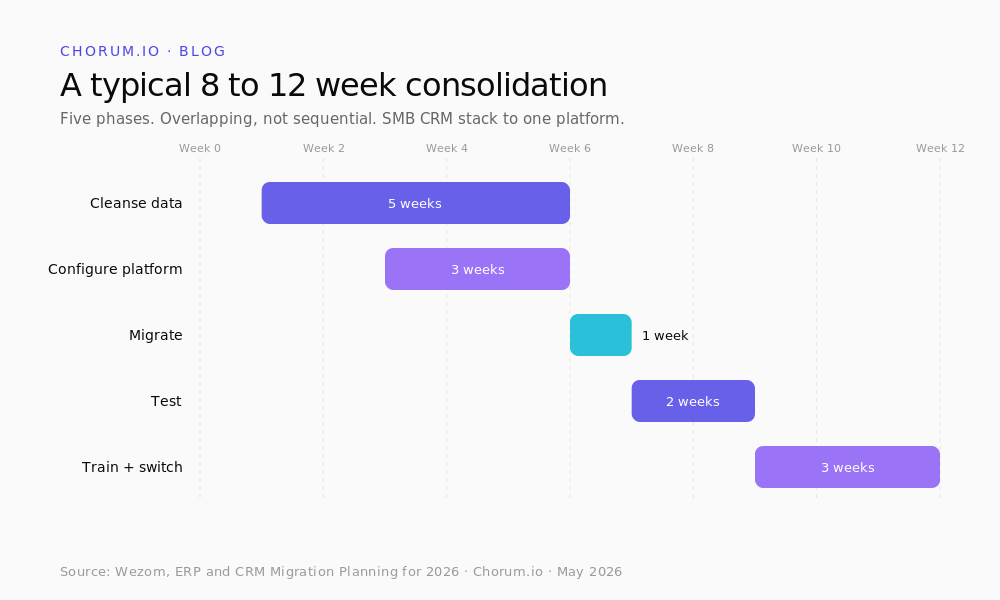
Cleanse the data (4 to 6 weeks). The biggest single phase by far. Deduplicate contacts, fix broken email formats, archive dead deals, retire ten-year-old support tickets. The new platform inherits the quality of what you migrate. Garbage in, garbage out.
Configure the new platform (3 to 4 weeks). Set up the CRM workflow that fits your industry, define your sales pipeline stages, build your support ticket categories, set up the integrations to Xero, Microsoft 365 or Google Workspace, payments. Do this in parallel with cleansing.
Migrate the data (1 to 2 weeks). Run the import scripts. Spot-check the records. Reconcile the totals. This is the phase people fear most and that takes the least time, provided phases one and two were done properly.
Test (2 to 3 weeks). Run the new platform alongside the old in pilot mode. New deals go in the new system, old deals stay in the old. After two weeks of clean operation, decide what to do about the old deals.
Train and switch (2 to 4 weeks). Train the team, ideally one or two people first, then the rest. Cut over. Cancel the old subscriptions on a date you have set in writing.
That is a 12 to 19 week range across the five phases. The 8 to 12 week industry figure assumes the phases overlap rather than running strictly in series, which they should.
What it actually feels like
Three honest predictions for a UK SMB doing this for the first time.
Week 4: regret
Around week four, when you are deep in data cleansing and have not yet seen any benefit, the team will ask why you started this. The card statement is now twice as high because you are paying for both the new platform and the old tools simultaneously. The answer is "this is the worst week, it gets better from here", and you press on.
Week 8: it clicks
Around week eight, the team starts to use the new platform reflexively for new work. Old tools become the place you look up history. Reports start coming out of the new platform. Finance notices that the SaaS bill, after the duplicate-paying period ends, is materially lower.
Week 12: cancel weekend
Around week twelve, you go through the old tool subscriptions and cancel them. This is the best Saturday morning of the year.
What it actually saves
Replacing the typical UK SMB stack with a single platform like Chorum.io, by the published 2026 prices:
Old stack (HubSpot + Xero + Zendesk + Mailchimp + Zapier): £90 to £110/month for one solo operator, ex VAT, depending on the dollar rate that day[8]
New stack (Chorum.io Professional + Xero kept): £29/user/month + £28/month Xero = roughly £57/month for one operator, ex VAT, fixed in pounds
That is roughly 40 to 50 percent monthly saving, and the saved amount becomes more reliable because Chorum.io is GBP-priced and Xero stays in your existing GBP plan. Add in the time saved (multiple hours a week of reconciliation), and the payback on the migration's effort is usually inside two months.
What about the migration risk?
The honest answer: there is real risk. People who tell you migrations are easy are selling you the platform. Things that go wrong:
Data loss. Records that exist in the old system but did not import properly. Fix: audit before migration, spot-check after migration, keep a read-only export of the old system for 6 months minimum.
Workflow gaps. The new platform does not do exactly what the old tool did. Fix: configure for the 80 percent that matters, accept the 20 percent will need a small workaround. The 20 percent was usually a workaround in the old tool too.
Team adoption. The team resents the change for the first month. Fix: do not present consolidation as "you have to learn a new tool". Present it as "you no longer have to switch between four tools to do one job".
Vendor lock-in. You are now dependent on one vendor instead of four. Fix: choose a platform that ships data export. Confirm before you start, not after.
None of these are blockers. They are just things to plan for.
Choosing the platform
Three checks before you commit:
UK pricing in pounds. If the platform's pricing page shows USD by default, the consolidation does not solve your currency exposure problem.
UK hosting and GDPR posture. Look for an explicit UK or EU data residency statement. SOC 2 alone is not enough for UK businesses.
Honest data export. The platform should let you export your data in a usable format any time, with no notice and no cost. If exit is hard, lock-in is the actual product.
Chorum.io ticks all three. UK-built, UK-hosted, billed in pounds, full data export. We use it on three of our own businesses. We are not the only option, but we built it because the option we wanted did not exist.
What is next
Two practical steps:
Run the audit. If you have not done it yet, start with the five-step audit. Even before any consolidation decision, the audit alone tells you what your real stack costs you.
Join the Chorum.io waiting list. We are taking on a small number of pilot customers across CRM, ERP, helpdesk and warehousing. Marketing and field services in design. UK-built, UK-hosted, billed in pounds. From £19 a user a month. Add your name here.
Either way, your stack should be a smaller number this time next quarter.
Sources
Kahneman, D. and Tversky, A. Prospect Theory: An Analysis of Decision under Risk. Econometrica, 1979. The seminal paper establishing that losses are weighted approximately twice as heavily as equivalent gains. PDF
Chorum.io blog. Why UK SMBs end up with five SaaS tools (and how to fix it). May 2026. /blog/why-uk-smbs-end-up-with-five-saas-tools
TheMarketingblog. HubSpot Pricing UK: The Complete 2026 Guide. March 2026. Sales Hub Starter £18 per seat per month ex VAT. themarketingblog.co.uk
Xero UK. Pricing Plans. April 2026. Grow plan £28/month ex VAT. xero.com/uk/pricing-plans
Zendesk. Support Pricing. 2026. Support Team plan from $19 per agent per month USD. zendesk.com/pricing
EmailToolTester. Mailchimp Pricing 2026. 2026. Mailchimp Standard from $20 per month USD for 500 contacts. emailtooltester.com
Wezom. ERP and CRM Migration Planning for 2026: Timelines, Costs, and Dependencies. 2026. SMB CRM consolidations typically 8 to 12 weeks; phase breakdown: cleanse 4 to 6 weeks, configure 3 to 4 weeks, migrate 1 to 2 weeks, test 2 to 3 weeks, train 2 to 4 weeks. Bad data quality adds 2 to 3 months. wezom.com
Chorum.io blog. Why UK SMBs end up with five SaaS tools (and how to fix it). May 2026, see "What it actually costs in 2026 prices" section. /blog/why-uk-smbs-end-up-with-five-saas-tools
Tom Adams is the founder of Chorum.io and Metis Solutions Group Ltd. He has run three of his own businesses on Chorum and consolidated more than one stack to do it. The cancel-the-old-subs Saturday is genuinely the best one of the year.